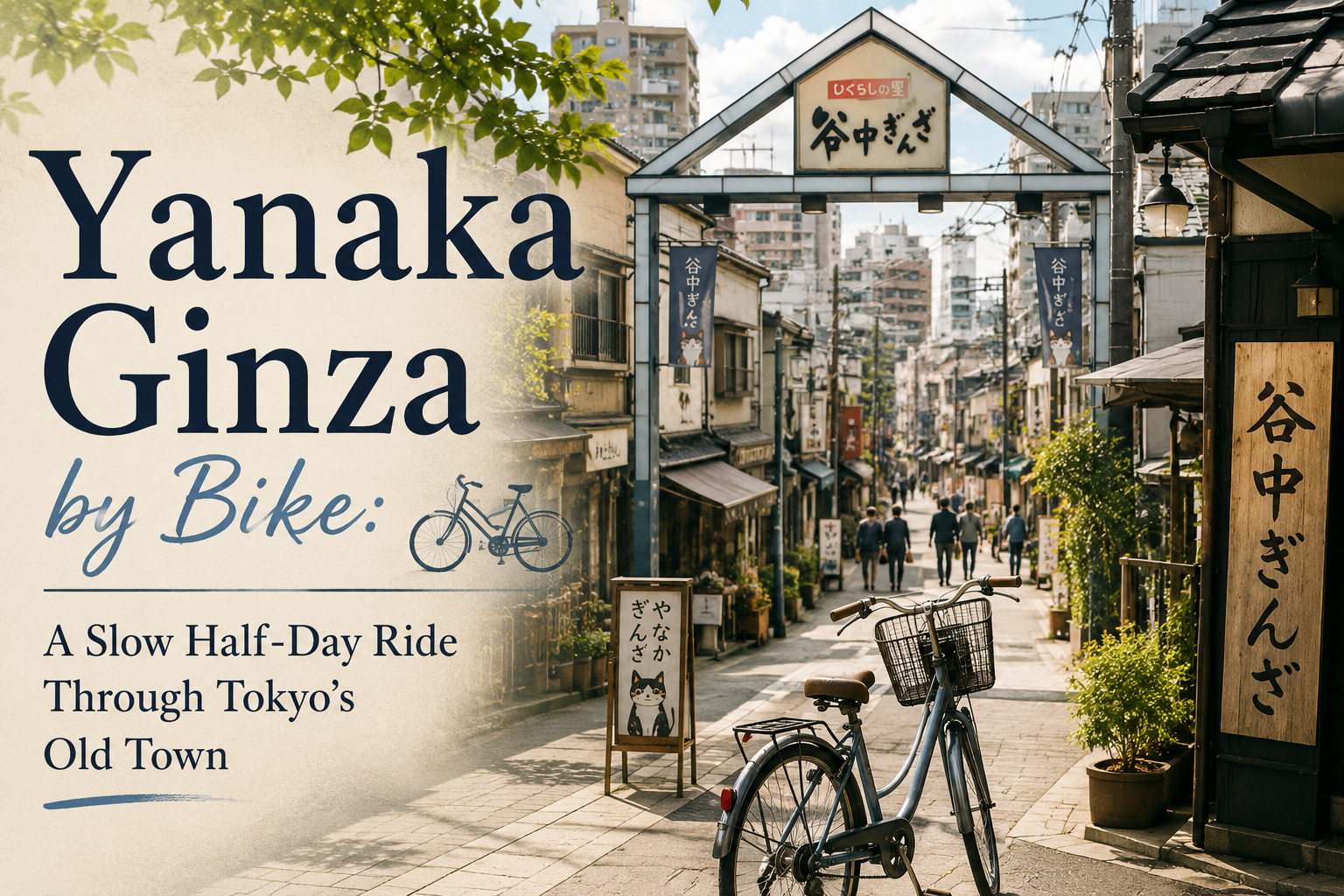
Most of Tokyo was flattened twice in the twentieth century — once by the 1923 earthquake, once by the war. Yanaka was not. Ride ten minutes north of Ueno and the city changes texture: wooden houses with tiled roofs, temple walls running the length of a block, a shopping street barely wider than a car, and stone steps that catch the sunset. This is the neighbourhood Tokyoites mean when they say shitamachi — the old low city.
It is also, quietly, one of the best places in Tokyo to have a bicycle. Not because the distances are long — the whole area fits inside a one-kilometre square — but because the trains work against you here. Nippori is a JR station; Nezu and Sendagi are on the Chiyoda subway line; there is no direct connection between them. On a bike, all three are five minutes apart, and you can string Yanaka together with Ueno, Akihabara and the Sumida River in a single day without queuing at a ticket gate.
Quick Facts (at a Glance)
- Riding distance: 8–10 km including detours
- Time needed: 4–6 hours at a proper wandering pace
- Terrain: One real climb, then a flat plateau, then a downhill finish
- Best start point: Ueno Station or Akihabara (4.5 km / about 25 minutes from Akihabara)
- Best season: Early April for cherry blossom in Yanaka Cemetery; August for lotus at Shinobazu Pond and shaved ice; late autumn for the clearest light
- Watch out for: Mondays — a startling number of shops here close on Monday
- Cash: Bring it. Several of the best shops on this route take nothing else
Getting Your Bike
You have two realistic options, and they suit different trips.
Rent a Proper Bike for the Day
CycleTrip BASE sits in Kanda Sudacho, a four-minute walk from JR Akihabara Station, and keeps around 200 sports bikes — cross bikes, road bikes, electric-assist city bikes and e-bikes. A cross bike is ¥4,500 for the first day (¥3,500 for each day after); electric-assist city bikes run ¥4,500–7,500 and e-bikes ¥7,500–10,000. A lock, lights and liability insurance are included; helmets rent as an add-on. Full English website, open every day, 09:30–17:30. That closing time is the real constraint on your day, not daylight. Shop to Yanaka Ginza: about 4.5 km, mostly flat, roughly 25 minutes.
Or Grab a Share Cycle
Both docomo bike share and HELLO CYCLING have good port coverage in Taito and Bunkyo wards, including ports in Yanaka itself, at Sendagi and at Ueno Station. Registration needs a smartphone that can receive SMS and a genuine credit card — test this before you travel, because some overseas carriers block international SMS and that will stop you at the sign-up screen. Day passes are also sold at 7-Eleven and FamilyMart without an app sign-up.
Two Warnings Before You Tap
You cannot return one operator’s bike to another operator’s port — docomo to docomo, HELLO CYCLING to HELLO CYCLING. That’s the most common visitor mistake. And pricing is in flux: docomo bike share is rebranding to NOLL with a new per-ten-minute structure and multi-hour tourist passes, with dates that have already shifted once. Check the app, not an article.
Which One Should You Choose?
For Yanaka alone, a share cycle is fine. To link Yanaka with the Sumida River or the Arakawa cycling path afterwards, rent a real bike.
Three Rules Before You Roll
Japan is stricter with cyclists than most visitors expect, and since April 2026 police can issue on-the-spot fines for cycling offences rather than just warnings. The three that matter most on this route:
- Ride on the left. Bicycles are legally vehicles here. Riding on the right-hand side is the error tourists make most, and it now carries a ¥6,000 fine.
- No phone in your hand — ever. Not for navigation, not for a quick photo while rolling. At ¥12,000 it is the largest fine on the list. Stop, put a foot down, then look at your screen.
- Park only in a designated bicycle lot. Tokyo wards run active impound sweeps. Retrieving a bike costs around ¥3,000, requires photo ID, and the depot is closed on Sundays — the exact day you would want it back.
Add to those a local one: Yanaka Ginza asks visitors not to eat while walking, which surprises people on a street built almost entirely around snacks. Most shops have a bench or an in-store spot. Use it.
The Route: Ride Clockwise from Ueno
The geography here is simple once you see it. Yanaka sits on the Ueno Plateau. Nezu sits down in a valley — the old course of a buried river. Every approach to Yanaka from the west or north is uphill, and the climb up Dangozaka from Sendagi is the steepest of them.
So ride it clockwise: climb once, gently, through Ueno Park on fresh legs, spend the middle of the day on the flat plateau, and coast down to Nezu at the end. If you are on an electric-assist bike none of this matters much, but on a rigid cross bike it makes a real difference.
1. Shinobazu Pond and Ueno Park
Start at the water. In midsummer the Hasu-ike basin of Shinobazu Pond disappears under lotus leaves, and the flowers open at dawn and close by mid-morning — a genuine argument for an early start. Ueno Toshogu, the gold-leaf shrine tucked into the park, is free to enter the grounds (09:00–17:30, March to September); interior viewing costs ¥700.
Cycling Note
Ride slowly and be prepared to push inside the park proper. There is a free 24-hour bicycle lot beside the baseball ground in Ueno Onshi Park — leave the bike there and walk the busy central section.
2. Ueno Sakuragi Atari
Climb gradually north-east out of the park and you arrive at a small courtyard of three restored 1938 wooden houses. Six tenants share it: a bakery working with domestic wheat, a shop selling tastable salts and olive oils, an antiquarian bookshop, and — the reason most people come — Yanaka Beer Hall, with its own microbrewery on site (11:00–20:00, closed Mondays).
A Word About That Beer
Drink-riding is a criminal offence in Japan with no permissive threshold for cyclists. If you want the beer, leave the bike at Nippori and finish the day on foot. This is the rule that gets visitors arrested rather than fined.
3. Yanaka Cemetery
Ten hectares, around 7,000 graves, and — this is the part nobody tells you — the best riding surface in the neighbourhood. Normal paved public roads run through it, quiet and gently graded, forming the natural link between Nippori and Ueno Sakuragi. The central avenue is called Sakura-dori for good reason: in early April it is a tunnel of cherry blossom, and considerably calmer than Ueno Park a kilometre south.
Look for the grave of Tokugawa Yoshinobu, the last shogun, behind its walled enclosure, and the foundation stones of the five-storied pagoda that burned down in 1957 — the one Kōda Rohan made famous in his novel. Ride slowly; people are visiting family here.
4. Tennoji and the Asakura Museum of Sculpture
Tennoji
Two minutes from Nippori Station, free, quiet, and holding a large seated bronze Shaka Nyorai in its grounds — a Kamakura-period foundation that later became one of Edo’s three official lottery temples.
Asakura Museum of Sculpture
Two hundred metres away, this is the best interior on the route: the studio-house of sculptor Fumio Asakura, built around a water garden, with a rooftop terrace. ¥500, 09:30–16:30, closed both Mondays and Thursdays. Practical notes that catch people out: shoes come off and socks are required, large bags and wheeled luggage aren’t admitted, and the building is emphatically not step-free.
5. Yuyake Dandan and Yanaka Ginza
Yuyake Dandan — a Dead End for a Bicycle
Now the postcard. Yuyake Dandan — “sunset steps” — is a 36-step stone staircase dropping from the Nippori side to the eastern end of Yanaka Ginza. It faces west, which is the whole point, and it is where every photograph of this neighbourhood is taken. Park at Nippori and walk down, or approach the street from the flat Sendagi end via Yomise-dori.
The Street Itself
About 170 metres of roughly 60 shops, grown organically since 1945. Technically it is an ordinary ward road, not a legally pedestrianised zone — but it is narrow, packed, and used by delivery vans. Get off and push. Everyone local does.
What to Eat and Buy Along It
- Niku no Satō — Yanaka menchi katsu, takeaway only, cash only, 10:30–19:30, closed Mondays. Its rival Niku no Suzuki is five minutes toward Nippori and sells out early.
- Yanaka Shippoya — baked doughnuts shaped like cat tails, thirteen or fourteen flavours. Cash only.
- Himitsudo — natural-ice shaved ice with house-made syrups, and the neighbourhood’s most notorious queue. Peak-summer waits run several hours, but they issue numbered tickets with timed return slots, which is exactly what a cyclist wants: take a ticket, go ride the cemetery loop, come back.
- Kikumi Senbei Sōhonten — rice crackers since 1875, one minute from Sendagi Station, distinctive square senbei, closed Mondays.
Find the Seven Cats
Keep your eyes up. Seven wooden cats, carved by Tokyo University of the Arts students in 2009, are hidden along the shopfronts and rooftops of Yanaka Ginza. Finding all seven is free and more fun than it has any right to be.
6. Hebi-michi, Kayaba Coffee and SCAI THE BATHHOUSE
Hebi-michi
Roll west and drop onto Hebi-michi, the “snake road” — a lane that wriggles between Sendagi and Nezu because it follows the buried course of the Aizome River. Flat, quiet, lined with small galleries and cafés. The best pure riding segment of the day.
Kayaba Coffee
At the bottom, on a corner everyone uses to give directions, Kayaba Coffee occupies a 1916 townhouse: a kissaten that opened in 1938, closed, and was brought back by local preservationists in 2009 with the original beams intact. 08:00–18:00, closed Mondays. The egg sandwich is the order. No parking, and walk-in queues are normal — reservations open online the day before.
SCAI THE BATHHOUSE
Directly opposite, a contemporary art gallery inside a 200-year-old public bathhouse, chimney and tiled roof still in place. Free, 12:00–18:00, closed Sundays, Mondays and holidays — and closed between exhibitions, so check the website before making the detour. The gallery now runs a second Roppongi venue too, and not every show it advertises is at this one.
7. Nezu Shrine — the Finish
Coast down into the valley to finish at Nezu Shrine, and it is worth understanding why this one is special. Seven of its structures, including the main hall, date from 1706 and are designated Important Cultural Properties — a complete Edo-period shrine complex that survived both the 1923 earthquake and the firebombing. That is close to unique in Tokyo.
Inside the grounds, the Otome Inari torii tunnel runs a compact vermilion corridor up the hillside: the Yanesen answer to Fushimi Inari, free, and usually far emptier. In April the azalea garden holds around 3,000 plants across a hundred varieties, with a small paid entry during the festival month.
From here it is a flat 1.8 km back to Ueno, or 3.8 km to Akihabara.
Where to Actually Park
This is the practical detail that makes or breaks a Yanaka bike day.
Nippori — Your Base for Yanaka Ginza
Nippori Station-front bicycle parking (1,270 spaces, open 04:30–01:00) gives you the first two hours free, then ¥100 up to eight hours. Yanaka Ginza, Yuyake Dandan and the Asakura Museum are all within a five-minute walk. The Nishi-Nippori lots have the same two-hours-free structure and stay open 24 hours.
Ueno
The lot beside the baseball ground in Ueno Onshi Park is free, 24 hours and unmanned. Gravel surface, so avoid it after heavy rain.
Nezu and Sendagi — Effectively Nothing
Bunkyo Ward’s lots here are monthly-contract only, with no casual use. If you are on a share cycle, return it to a port near Nezu Shrine; if you are on a rental, lock up at Nippori and walk down.
Wrap-Up
Yanaka rewards a particular kind of traveller: the one happy to cover four kilometres in five hours. The bicycle is not here to save you time — it is here to let you follow a lane because it looks interesting, double back for the senbei shop you rode past, and reach three stations’ worth of neighbourhood without descending into a single one.
Start early for the lotus, climb once through Ueno Park, spend the afternoon on the plateau among the temples and the cats, and finish freewheeling down toward Nezu with a paper bag of menchi katsu in the basket. Check what’s closed on Mondays, bring cash, keep your phone in your pocket while you ride — and let the neighbourhood set the pace.