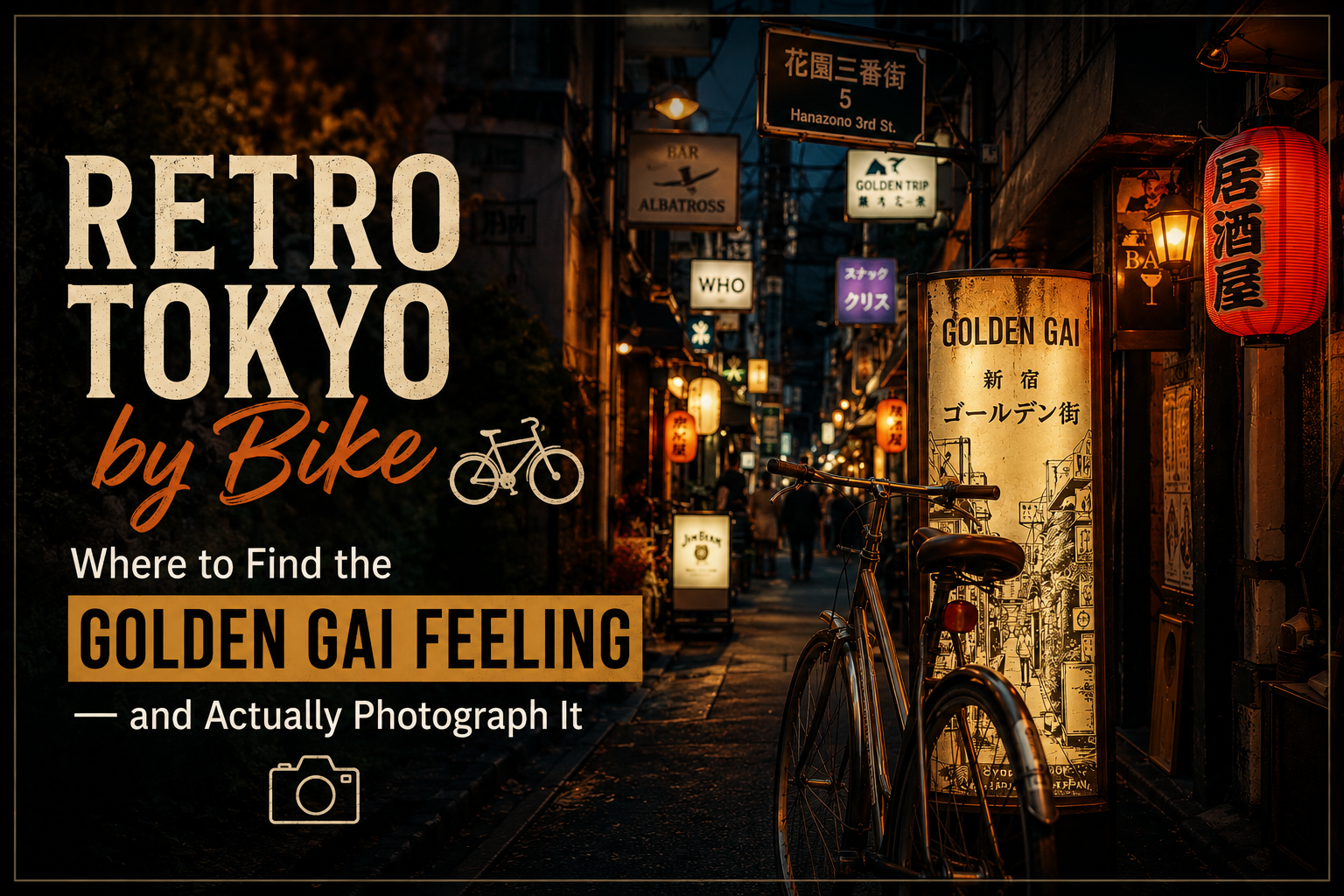
You know the photograph. A lane barely wide enough for two people. Hand-painted signs stacked up a two-storey wooden wall. Paper lanterns, tangled wiring, warm light spilling out of a door that only fits six customers. Shinjuku’s Golden Gai is where most visitors go looking for it, and Golden Gai delivers — right up until you raise a camera.
Because here is the thing almost no guide tells you: the alleys of Golden Gai are private land, not public road. That single fact changes everything, and we’ll come back to it.
The better news is that the feeling you are chasing is not unique to Golden Gai. It survives across eastern Tokyo — pre-war shopfronts that dodged both the 1923 earthquake and the 1945 firebombing, brick railway viaducts from 1912, wooden lanes, bathhouses built like shrines. Those places are flat, close together, far more relaxed about a camera, and genuinely best reached by bicycle.
Quick Facts (at a Glance)
- The loop: Kanda Sudacho → Manseibashi → Ueno → Ningyocho → Tsukudajima → Ginza → Yurakucho → back
- Distance: about 20 km · Riding time: around 1 h 45 min · Realistic day: 7 hours
- Terrain: Flat. This is all reclaimed lowland at roughly sea level
- Best light: Morning for the buildings, golden hour for Tsukudajima, evening for the railway arches
- Bike parking: Chuo City lots give the first two hours free — which makes this route almost free to park all day
- Golden rule: Ask before you photograph anyone or any shopfront. Every time
The Honest Problem with Golden Gai
The Alleys Are Private Property
Golden Gai is governed by three bodies — two shopkeepers’ associations and a landowners’ cooperative — and their published position is unambiguous. The association’s own notice states that all the land in Golden Gai is privately owned, that photography there requires permission and is chargeable, and — this is the sentence that matters — that permission is needed even for a shot of the streetscape or a close-up of a sign.
The fee schedule is real and public: roughly ¥100,000 an hour for a commercial, ¥40,000 for commercial stills, ¥10,000 an hour for press photography, and ¥10,000–20,000 an hour even for students and hobby groups. Approved shoots wear an armband, are capped at twenty people, and are generally not approved during business hours.
What That Actually Means for You
In practice a quiet phone snapshot is usually tolerated, and enforcement targets crews with tripods and lights rather than tourists. But there is no published exemption you can point to, and it is worth understanding why the rule exists: it predates the inbound tourism boom by more than a decade. This is not a reaction to visitors. It is a neighbourhood of tiny owner-run bars protecting itself from being treated as a film set.
The respectful approach, and the one this article recommends: go to Golden Gai to drink, not to shoot. Keep the camera down in the alleys. Never photograph a shopfront close-up or a person without asking. No tripod, no flash. If you want the district in a frame, shoot it from the public streets at its edges — the Hanazono-dori and Yasukuni-dori sides.
Omoide Yokocho Has Rules Too — and a Name It Doesn’t Want
The alley beside Shinjuku’s west exit publishes its own policy: applications ten days in advance, a planning meeting, ¥30,000 per thirty minutes, weekday daytime slots only, crews capped at three people, and tripods and flash prohibited outright.
There is also a request English guidebooks almost universally ignore. The association asks that the nickname Shonben Yokocho — “Piss Alley” — not be used, and that the district be called by its actual name, Shinjuku West Exit Omoide Yokocho. It costs nothing to get that right.
The practical line for a visitor: the alley itself, shot discreetly from the end, is not the problem. The moment you point a lens down a six-seat counter at someone eating, it is. Several shops post their own no-photography signs. Read them.
The One Rule That Covers Everything
Tsukiji Outer Market publishes an eight-point manners list, and rule number two is the cleanest formulation of this entire subject: ask before you photograph. Some shops post notices; some don’t; asking works in both cases. Japan has no dedicated portrait-rights statute — the right is judge-made, derived from constitutional and tort principles, and it turns on whether an identifiable person’s privacy was intruded on beyond what is socially reasonable. But that whole analysis only applies on public land. Step onto private property and the owner simply sets the terms.
So Ride the East Instead
Golden Gai, Omoide Yokocho and Shibuya’s Nonbei Yokocho are eight to ten kilometres west of the bike shop, uphill, in strict no-parking districts, best after dark, and the most photography-restricted places on the whole list. Riding to them is the worst possible way to see them. Do them on foot on a separate evening.
The east is the opposite in every respect — flat, cheap to park, photogenic in daylight, and dense enough that you are stopping every ten minutes.
Getting a Bike, and the Evening Problem
Rent for the Day
CycleTrip BASE sits at Kanda Sudacho 2-9, four minutes from JR Akihabara. A cross bike is ¥4,500 for the first day (¥3,500 after), electric-assist city bikes ¥4,500–7,500, with lock, lights and liability insurance included. Open daily 09:30–17:30. Conveniently, the first stop on this route is 200 metres from the shop door.
Lights After Dark Are Now a ¥5,000 Fine
Since 1 April 2026, Japanese police can issue on-the-spot fines to cyclists aged sixteen and over. Riding without lights costs ¥5,000. A phone in your hand costs ¥12,000 — relevant, because you will be tempted to check a map or a photo while rolling. Riding on the pavement where it isn’t permitted is ¥6,000. And drink-riding is not a fine at all but a criminal offence with no permissive threshold, which matters when the destination is a bar street.
Ride the Day, Walk the Night
Here is the honest conflict. In September, sunset in Tokyo falls between about 17:30 and 18:00 — almost exactly when the rental shop closes. The lanterns come on just as your bike has to go back.
Three ways to handle it, best first:
- Return the bike by 17:30 and take the train. Kanda to Shinjuku is twelve minutes. Cleanest solution, no parking risk, and you can drink.
- Park and walk. Finish the ride at a 24-hour lot near Shinjuku — the Seibu Shinjuku Station lot gives two hours free and stays open around the clock — and do the yokocho on foot. Note that Tokyu Kabukicho Tower’s lot, the closest to Golden Gai, closes at 01:00, so a late night strands your bike.
- Share cycle for the evening leg. Docomo bike share runs 24 hours across every ward here, with a port at the Shinjuku ward office a block from Golden Gai. Check the light actually works before you ride off.
The Route, Stop by Stop
1. Kanda Sudacho — the Block That Survived
Two hundred metres from the bike shop, and the best-kept secret in central Tokyo. This block escaped the fires of both 1923 and 1945, which is the only reason it still stands.
Takemura
A three-storey wooden sweet shop from 1930, with hand-carved bamboo and plum motifs on the second-floor railings and a circular wooden roof lantern. It is a Tokyo-designated historic building and a Chiyoda City landscape asset. Open Tuesday to Saturday, 11:00–20:00 — closed Sundays, Mondays and public holidays, which catches a lot of weekend visitors out.
Kanda Matsuya and Isegen
Matsuya has been making soba here since 1884, in a pure timber building with two large lanterns under the eaves, also Tokyo-designated. Weekdays 11:00–20:30, closed Sundays. Isegen, an ankō hotpot house dating to 1830, occupies the corner opposite — note that anglerfish is a winter dish and the shop’s closing pattern changes with the season.
Ebihara Shoten and the Art of the Signboard
The photographic prize on this block is Ebihara Shoten at Kanda Sudacho 2-13 — the same block as the bike shop. It is a textbook specimen of kanban kenchiku, “signboard architecture”: the shop-house type that emerged after the 1923 earthquake, where the entire street façade is clad flat in copper, mortar or tile like a single signboard, hiding an ordinary timber building behind it. Narrow frontage, deep plan, a mansard roof sneaking a third storey under the height limit. Unusually, this façade was designed by a painter rather than a carpenter.
It is not a shop you can walk into — treat it as an exterior subject, and look for the copper-clad and tiled façades on the surrounding streets. The neighbourhood is thinning: Chiyoda City’s own heritage list already marks some of these buildings as demolished.
2. mAAch ecute Kanda Manseibashi — 1912 Brick and Moving Trains
Six hundred metres west, and probably the single best photograph on the route. The red-brick Manseibashi viaduct was completed in 1912; the station closed in 1943 and the arches sat unused for decades before reopening as a shopping and café complex in 2013.
Both the original 1912 staircase and a 1935 staircase are restored and walkable. At the top, the 2013 Platform puts you standing on the old station platform deck with live Chuo Line tracks running either side — trains pass on both sides of you, a metre away, against a hundred-year-old brick wall. Open from 11:00, closing around 22:00 on weekdays and Saturdays.
3. The Brick Arches North to Ueno
The viaduct keeps going. Follow the arches north-east and they run continuously for roughly two kilometres under the Yamanote and Tohoku lines through ChabaRa and 2k540 AKI-OKA ARTISAN, a strip of craft studios and workshops built into the arch bays. It is an easy, atmospheric ride alongside brick the whole way.
At the end is Ameyoko, the postwar market street under the Ueno tracks. Push, don’t ride — it is nominally a walking street and practically impassable at speed anyway.
Tsubameyu
Two minutes off Ameyoko at Ueno 3-14-5 stands Tsubameyu, built in 1950 to replace a bombed predecessor and the first public bathhouse in Tokyo to be registered as a national cultural property, in 2008. It opens at 06:00 and closes at 20:00, shut Mondays and Tuesdays. Photograph the frontage from the street — never inside, and never someone going in or out.
4. Ningyocho and Kabutocho
Three kilometres south into a district that keeps surprising people. Along Daimon-dori, Ningyocho-dori and the lane called Geisha Shindo you will find a run of surviving kanban kenchiku shopfronts — a tantanmen shop, a copper-clad tofu maker, a Showa tile-fronted sushi restaurant — and, on Geisha Shindo itself, an early-Showa two-storey timber former geisha house that is a registered national cultural property and still operating as a restaurant. Amazake Yokocho is the named strip everyone photographs.
A few hundred metres on, Kabutocho and Kayabacho give you the same textures with almost no visitors in the frame.
5. Tsukudajima — Save This for Golden Hour
Two and a half kilometres south-east across the Sumida, and the best set on the route. Tsukudajima is a small island of surviving wooden houses and narrow lanes wrapped around a boat inlet, with the red Tsukuda Kobashi bridge across it and Sumiyoshi Shrine behind. The tsukudani shops that gave the place its name are still trading.
The composition writes itself: 1930s wooden eaves in the foreground, glass towers directly behind them, water in between. Low sun does the rest. One block east is Tsukishima’s monja street if you want dinner.
6. Ginza: the Okuno Building
Two kilometres west, at Ginza 1-9-8, stands something most visitors to Ginza walk straight past. The Okuno Building was completed in 1932 as the Ginza Apartments — a luxury block by Kawamoto Ryoichi, the architect of the Dojunkai apartments — in scratch tile, seven storeys over a basement, originally overlooking the willows of a canal that no longer exists.
The manual accordion-door elevator still runs. The second-floor corridor floor is visibly worn from ninety years of feet. Twenty-odd small galleries and antique dealers occupy the rooms now, with exhibition notices papering the corridors, and the preserved original apartment known as Room 306 opens for exhibitions on its own schedule — check their calendar rather than turning up hopefully.
Etiquette matters here: this is a working building full of private galleries. The corridors and the elevator are the picture, but ask inside whichever gallery you are standing in, don’t shoot through open doorways, and don’t hold the lift for a photo.
7. Yurakucho Under the Tracks
Finish where the light is artificial and that is the point. Hibiya OKUROJI, opened in 2020, runs roughly 300 metres of restored brick arches between Yurakucho and Shimbashi with around fifty small bars and shops in the bays. Ginza Corridor-gai runs alongside. Trains rumble overhead, the brick is uplit, and it photographs beautifully at dusk without a single restriction to worry about.
From here it is two and a half kilometres back to Kanda.
Worth the Detour, on Borrowed Time
Tateishi — Half of It Is Already Gone
This one needs care, because guides still get it wrong in both directions. Nonbe Yokocho, the drinking warren on Tateishi’s north side, stopped trading in September 2023 after some seventy years and has been demolished; construction on the north-exit redevelopment began in November 2025 and runs to 2029. Do not send yourself there.
But Tateishi Nakamise, on the south side of the tracks, is still open and still trading — roughly 120 metres of covered arcade with butchers, greengrocers and cheap eateries, and about as intact a Showa market street as remains in Tokyo. It sits inside its own redevelopment zone, with demolition currently projected for around 2029. Go while you can.
Sangenjaya’s Triangle
The sankaku chitai — the wedge of drinking alleys between Setagaya-dori and Route 246 — is still standing, despite being widely reported as doomed. The redevelopment has not even reached a formal planning decision. One commentator described it as a town that has been slated for redevelopment for forty-four years. It is one of the best surviving postwar warrens in the city, and it is west and hilly — a separate ride, not part of this loop.
Kita-Senju
Eight kilometres north, and worth a day of its own. The old Nikko Kaido post-town street survives with stone paving and an arch, and the Edo-period Yokoyama merchant house still stands on it. The subjects locals point to are the triple corrugated-iron buildings in the Daikon district and the bare-bulb wooden power poles in the Yanagihara lanes. Seven working bathhouses remain.
One correction while we’re here: the famous Daikokuyu of Kita-Senju, the “King of Sento,” closed in 2021 and was demolished in 2022. Its gabled roof was relocated to Anyoin temple, where you can still see it. The Daikokuyu in Sumida is a different bathhouse and is fine.
Shotengai: Push, Don’t Ride
Tokyo’s covered shopping streets are among the most photogenic places on this list and among the least tolerant of a moving bicycle. The Metropolitan Police are explicit about designated pedestrian roads: get off and push. Musashi-Koyama’s Palm arcade and Jujo Ginza both say so on their own websites.
Worth building a ride around: Sunamachi Ginza in Koto (670 metres, 180 shops, best in the morning and shut by late afternoon), which pairs naturally with Kiyosumi; Jujo Ginza in Kita; and Togoshi Ginza in Shinagawa, Tokyo’s longest at about 1.3 km. Musashi-Koyama’s Palm has its own bicycle lot with the first three hours free — and the streets around it are an active impound zone, so use it.
The same applies to pedestrian-paradise hours: Ginza’s Chuo-dori goes car-free on weekends and holidays, Akihabara’s on Sundays, and bicycles are prohibited rather than merely discouraged. From April to September those run to 18:00; from 1 October they end an hour earlier.
Wrap-Up
The photograph you came for is not really about lanterns. It is about a city where a 1930 sweet shop, a 1912 railway arch and a 1932 apartment block with a hand-operated lift all survived the century by accident, and are still being used for their original purpose by people who live there.
Ride the flat east in daylight, when those buildings are the subject and nobody minds a camera. Park properly — Chuo City’s two-hours-free rule means a whole day of this costs almost nothing. Save the yokocho for the evening, on foot, with a drink in front of you instead of a lens. And when in doubt, ask first. It’s the market’s own rule, and it has never once made a photograph worse.