Tokyo’s pop-culture districts have a scheduling problem. Akihabara, Nakano Broadway and Ikebukuro’s Otome Road are each worth half a day — but they sit on three different railway lines, and stitching them together by train means three transfers, three sets of stairs, and a slow bleed of energy at ticket gates. Add Jimbocho’s used-manga shops or Koenji’s vintage racks and the day dissolves into logistics.
A bicycle solves this almost embarrassingly well. Central Tokyo is flat, the districts are 6 to 8 km apart, and the route between them — the back streets shadowing the Chuo Line, the quiet grid west of Shinjuku — is some of the most pleasant urban riding in the city. The whole loop is about 30 km, which sounds like a lot until you realise it is roughly two hours and fifteen minutes of actual pedalling spread across a full day.
This is a route for people who already know what a doujinshi is. It assumes you want shop time, not photo stops.
Quick Facts (at a Glance)
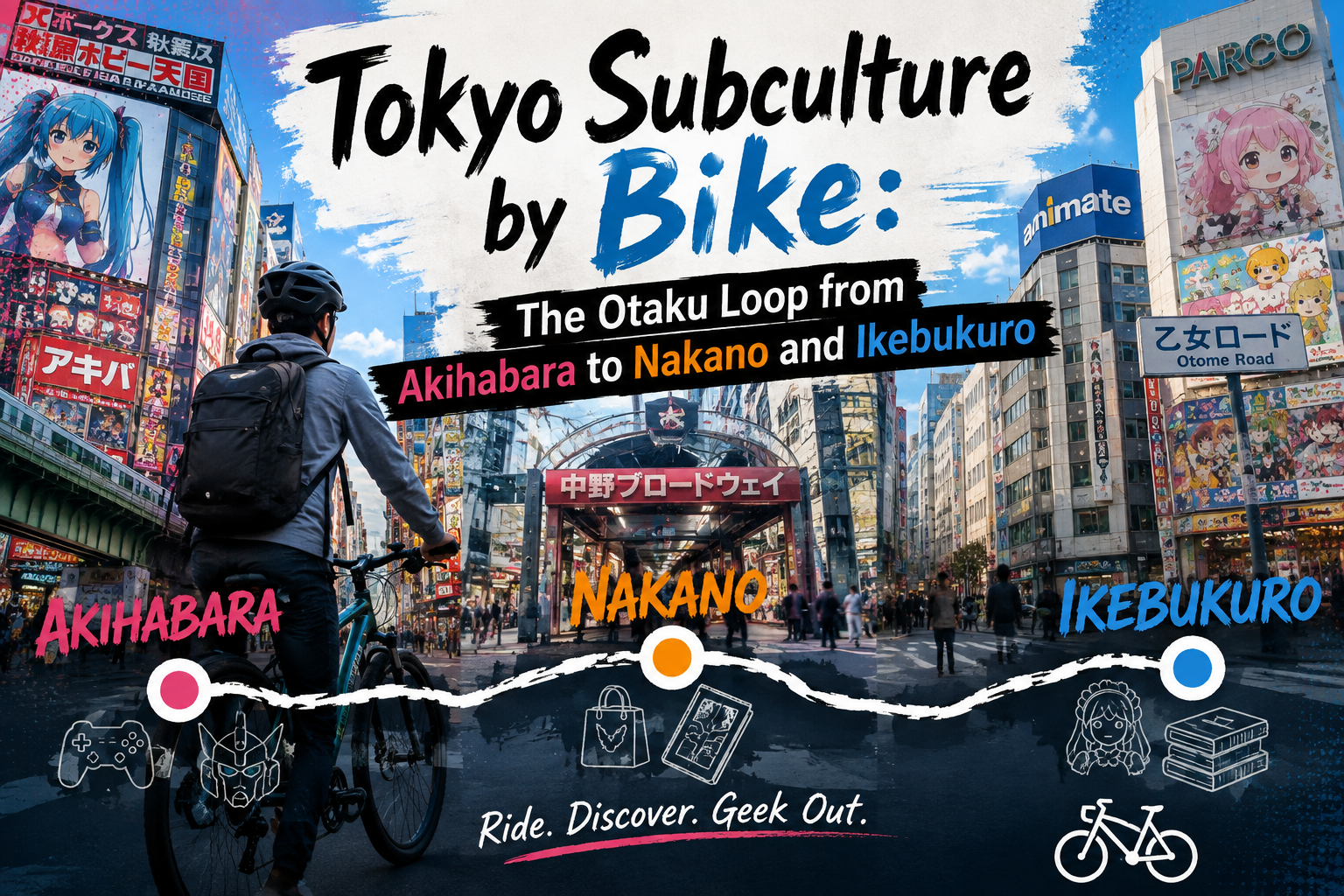
- The loop: Akihabara → Jimbocho → Shinjuku → Koenji → Nakano → Ikebukuro → Akihabara
- Distance: ~30 km · Riding time: ~2 h 15 min · Realistic day: 8 hours
- Terrain: Flat, with two short climbs (Kanda Myojin’s bluff, the Mejiro escarpment)
- Bike type: Electric-assist strongly recommended — stop-start city riding tires you out far more than the distance suggests
- Hard constraint: Your rental shop’s closing time, not sunset
- Best day: Any weekday. Saturday works. Sunday changes the plan (see below)
Why a Bike Genuinely Beats the Train Here
Akihabara to Nakano by train is 35–40 minutes with a change and a walk at each end; by bike it’s about 45 minutes of continuous riding, but you arrive at the door with no stairs and no waiting. You can also carry what you buy — anyone doing a serious Mandarake or K-BOOKS run ends the day with several kilos of books and boxes, and a basket changes the entire experience. And you see the joins: the stretch between Nakano and Koenji, the residential grid north of Shinjuku, the shotengai you pass through without meaning to. That’s where Tokyo actually lives, and the train buries all of it underground.
Getting a Bike
CycleTrip BASE — Rent for the Whole Day
CycleTrip BASE is the natural base for this loop. Despite the name it sits in Kanda Sudacho — a four-minute walk from JR Akihabara Station, one minute from Iwamotocho — with around 200 sports bikes: cross bikes, road bikes, electric-assist city bikes and e-bikes. A cross bike is ¥4,500 for the first day (¥3,500 per day after that); electric-assist city bikes run ¥4,500–7,500 and e-bikes ¥7,500–10,000. Lock, lights and liability insurance are included; helmets rent as an extra. Site and support run in English. Bring your passport.
Internalise the 17:30
Hours are 09:30–17:30, every day. That closing time is what will actually shape your day — you cannot do an evening neon ride and return the same bike.
Share Cycles — Short Hops Only
docomo bike share (now rebranding to NOLL) and HELLO CYCLING cover every ward on this route and work well for short hops. For 30 km across a full day they no longer make financial sense: recent price rises pushed both systems toward per-15- and per-10-minute billing. Share cycle for one district; rent a real bike for the loop.
The Rules Changed in 2026 — Read This Part
Since 1 April 2026, Japanese police can issue on-the-spot fines to cyclists aged 16 and over rather than only warnings, and foreign visitors are not exempt.
The Fines Most Likely to Catch You
| Violation | Fine |
|---|---|
| Phone in hand while riding | ¥12,000 |
| Running a red light | ¥6,000 |
| Riding on the right-hand side | ¥6,000 |
| Riding on a sidewalk where it isn’t permitted | ¥6,000 |
| No lights after dark | ¥5,000 |
| Riding with earphones in | ¥5,000 |
| Not stopping at a 止まれ sign | ¥5,000 |
The Three Visitors Always Get Wrong
Ride on the left — bicycles are vehicles in Japan. Sidewalks are off-limits by default, permitted only where a sign says so, and even then you ride slowly on the road-side half and yield to pedestrians. Take your earphones out; nobody expects this one.
Drinking, and Where to Leave the Bike
More seriously than any fine: drink-riding is a criminal offence, and there is no permissive blood-alcohol threshold for cyclists in Japan. One beer in Nakano and you push the bike home.
And park properly. Akihabara’s Chuo-dori, Kabukicho, Ikebukuro east side and the streets around Nakano Station are all no-parking zones with active removal sweeps. Recovery costs around ¥3,000, needs photo ID, and the depots keep office hours. Every district below has a proper lot, most with the first hour or two free.
The Loop, Stop by Stop
Akihabara — Start Here, but Start Early
Give Akihabara two hours at the front of the day, not the back.
The Essential Stops
- Akihabara Radio Kaikan (10:00–20:00) — ten floors of specialist tenants: K-BOOKS on 3F, amiami on 4F, Kaiyodo Hobby Lobby on 5F, Yellow Submarine on 6F, Volks on 8F. The most efficient single building in the district.
- Mandarake Complex (12:00–20:00, open 365 days) — eight floors, each with a clear identity: vintage manga on 3F, male doujinshi on 4F, female doujinshi and dolls on 5F, toys on 6–8F. Note the noon opening; do Radio Kaikan first.
- Super Potato (11:00–20:00) — retro games across three floors, with a playable arcade and a dagashi corner on 5F.
- Akihabara Gachapon Kaikan — several hundred capsule machines near Suehirocho.
- Animate Akihabara (10:00–21:00) — two buildings plus an annex with a café.
- Arcades: GiGO’s Building 1 closed in 2025 and was replaced by Silk Hat Akihabara — eight floors, Gundam cabinets in the basement, rhythm games at the top. GiGO Buildings 2 and 3 and Taito Hey, still the district’s hardcore retro and shoot-’em-up arcade, are unchanged.
On Maid Cafés, Honestly
The real thing has thinned out dramatically — from over a hundred at the peak to fewer than thirty. What fills the street now are concept cafés with bar-style pricing and aggressive touting. Book an established chain with an English site in advance rather than following someone handing out flyers on Chuo-dori.
Sunday Note, and Where to Park
Chuo-dori becomes a pedestrian paradise on Sunday afternoons (13:00–18:00 April–September, 13:00–17:00 October–March), and bicycles are explicitly banned from it. Park and walk, or ride the loop on a different day. The best lot is the roofed one under the viaduct at Akihabara Station’s Central Exit — 120 spaces, two hours free, then around ¥100 per ten hours.
Kanda Myojin — Four Minutes and One Short Hill
Worth the detour even if you have no interest in shrines. Kanda Myojin is Akihabara’s local shrine, which means it sells amulets blessing IT equipment and successful software launches, and it has been a Love Live! pilgrimage site for over a decade. The official collaboration goods are gone, but the ema board is still covered in hand-drawn fan art.
The EDOCCO complex in the grounds is not a tourist trap: it holds a genuine event hall that hosts anime and idol events, a shop, and a café that turns into an oden-and-sake bar after 18:00. Grounds open 24 hours; amulets and goshuin until 17:00.
Jimbocho — 1.7 km, and Skip It on Sunday
Seven to nine flat minutes west along Yasukuni-dori brings you to a district of roughly 130 second-hand bookshops. The ones that matter here are the manga antiquarians — Yumeno Shoten, Nakano Shoten’s manga department, @Wonder — where pre-war and early-Showa material turns up at prices that make Mandarake look casual.
Two Caveats
Most of these shops close on Sundays and public holidays, and many shut around 18:00. And Yasukuni-dori is a wide, busy arterial — drop one block south into the Suzuran-dori back streets, which are calm and lined with the same shops.
One correction to older guides: Comic Takaoka, the famous manga bookshop, closed permanently in 2019.
Shinjuku — a Pass-Through with Two Stops
Yasukuni-dori runs almost the whole way from Jimbocho to Shinjuku, about 30 minutes. Two things justify stopping. The Godzilla Head on the Toho Building in Kabukicho roars and lights up on the hour, 12:00–20:00, free to watch from street level on Godzilla Road — but don’t plan on the 8F terrace, which has been closed to visitors for some time. And Tokyu Kabukicho Tower, 48 floors with no offices in it at all, where namco TOKYO on 3F is Bandai Namco’s flagship arcade-and-bar (11:00–23:00 weekdays, later at weekends).
Another correction worth making: the Samurai Museum in Kabukicho has been closed since 2022 and still is. Robot Restaurant closed in 2020. Both are still all over search results.
Koenji — the Best 45 Minutes on This Route
From Shinjuku it is about 25 minutes west. Take the residential grid rather than Ome-kaido, which is heavy with traffic.
Koenji is Tokyo’s vintage-clothing capital and, unlike some scenes, still growing — local shops are actively pushing to make it the city’s next fashion district. Beyond the racks there are live houses, record shops, junk and antique dealers, and the wonderfully strange Kita-Kore Building. In late August the Koenji Awa Odori fills the streets with well over a million people: brilliant to witness, impossible to cycle.
The shotengai — Look Street, Pal, Junjo Shotengai — are narrow and pedestrian-dense. Walk the bike.
Nakano Broadway — Give It 90 Minutes Minimum
Eight minutes east of Koenji, at the end of the Sun Mall arcade. Nakano Broadway contains more than thirty separate Mandarake shops, each specialising in something different: vintage anime cels, Showa-era toys, idol photos, tokusatsu, plastic models, rare manga. All open 12:00–20:00, 365 days a year; most of the rest of the building runs roughly 10:00–20:00. Also inside: TACO ché for independent zines and underground comics, Robot Robot for vintage figures, and Daily Chiko’s absurd eight-tier soft-serve in the basement.
Navigate by the Arcade, Not by Old Landmarks
Nakano Sunplaza is gone — demolition was confirmed in 2026 and the replacement is not due until the mid-2030s. The north exit is a construction site.
Parking
The underground lot at Nakano Shiki-no-Mori Park is enormous (1,500 spaces, ¥100 a day, 24 hours). Nakano Central Park is indoors with two hours free.
Ikebukuro — the Other Half of the Story
About 25 minutes north-east, via Yamate-dori or the Mejiro-dori route. This is where the loop earns its keep, because Ikebukuro is the counterweight to Akihabara: where Akihabara’s retail is built around a male otaku audience, Ikebukuro’s is built around a female one, and the difference in what’s on the shelves is immediate.
- Otome Road — a 200-metre strip along the east side of Sunshine 60-dori, dense with BL, otome-game and doujinshi retail. It has been renewing rather than fading: K-BOOKS has relocated and reopened branches through 2025 and 2026, and now runs over twenty shops in Ikebukuro alone (weekdays 12:00–20:00, weekends from 11:30).
- Animate Ikebukuro — the rebuilt flagship tower, billed as the world’s largest anime store. Nine floors plus basements: a 208-seat theatre in B2, manga and light novels on 2–3F, goods on 4–5F, a card-play space on 6F, only-shops on 7F, a gallery on 8F, event halls on 9F. 10:00–21:00 daily. The store asks visitors to arrive by public transport — park properly and walk the last block.
- Sunshine City — home to the Gashapon Department Store flagship on 3F of the World Import Mart building, with over 3,000 machines and a Guinness certificate to prove it. Also the aquarium, planetarium and NAMJATOWN.
- Pokémon Center MEGA TOKYO on Alpa 2F — check before you go. The store was closed for much of 2026 and reopened in late August with entry restrictions for a period afterwards.
- Cafés: animate Café rotates themes every two or three weeks, and Swallowtail Butler Café — reservation-only — is the direct counterpart to Akihabara’s maid cafés.
Parking, and the Ride Home
Sunshine City runs three lots, 24 hours, first hour free then about ¥150 per two hours. From here it’s roughly 8 km and half an hour back to Akihabara — and if you’ve timed it well, you roll in just before the shutters come down at 17:30.
Worth Adding, on a Second Day
Suginami Animation Museum
In Ogikubo, and the most bike-friendly museum in this entire article: free admission, 10:00–18:00, closed Mondays, with bicycle parking at the main entrance. About 20 minutes west of Nakano along the Chuo Line back streets. Pair it with Kichijoji for a nice 10 km west-Tokyo day.
Ghibli Museum, Mitaka
Don’t try to fit this into the main loop. It’s 21–23 km from Akihabara and entry is by advance timed reservation only, with overseas tickets released at 10:00 JST on the 10th of the month for the following month. Take the train to Kichijoji and walk through Inokashira Park, or ride out from Ogikubo.
Shibuya PARCO 6F
Nintendo TOKYO, Pokémon Center Shibuya, CAPCOM STORE TOKYO and JUMP SHOP on one floor that opens an hour before the rest of the building. Numbered entry tickets at busy times.
Odaiba — and a Real Cycling Curiosity
Bicycles cannot be ridden across the Rainbow Bridge, but you can cross it: at the promenade entrance you borrow a small dolly, mount your rear wheel on it, and push the bike the 1.5 km across (09:00–21:00 April–October, shorter in winter, closed the third Monday of the month). Twenty to thirty minutes, extraordinary views. If you’d rather not, ride Harumi Ohashi via Toyosu — fully rideable, and it drops you near teamLab Planets.
If the Giant Robot Was Your Reason for Going
The Unicorn Gundam statue’s display at DiverCity ended on 31 August 2026. Check the current situation before riding out. The Gundam Base Tokyo on DiverCity’s 7F is unaffected.
Wrap-Up
Ride it in this order — Akihabara early, Jimbocho on the way through, Shinjuku as a two-stop pause, then Koenji, Nakano and Ikebukuro with the afternoon ahead of you — and the day gains a rhythm the train version never manages. You arrive at each door instead of each station. You carry what you buy. And the twenty-minute stretches in between stop being dead time and start being the part you remember.
Get an electric-assist bike. Ride on the left, keep the phone in your pocket, park in a proper lot, and save the beer for after you’ve handed the bike back.