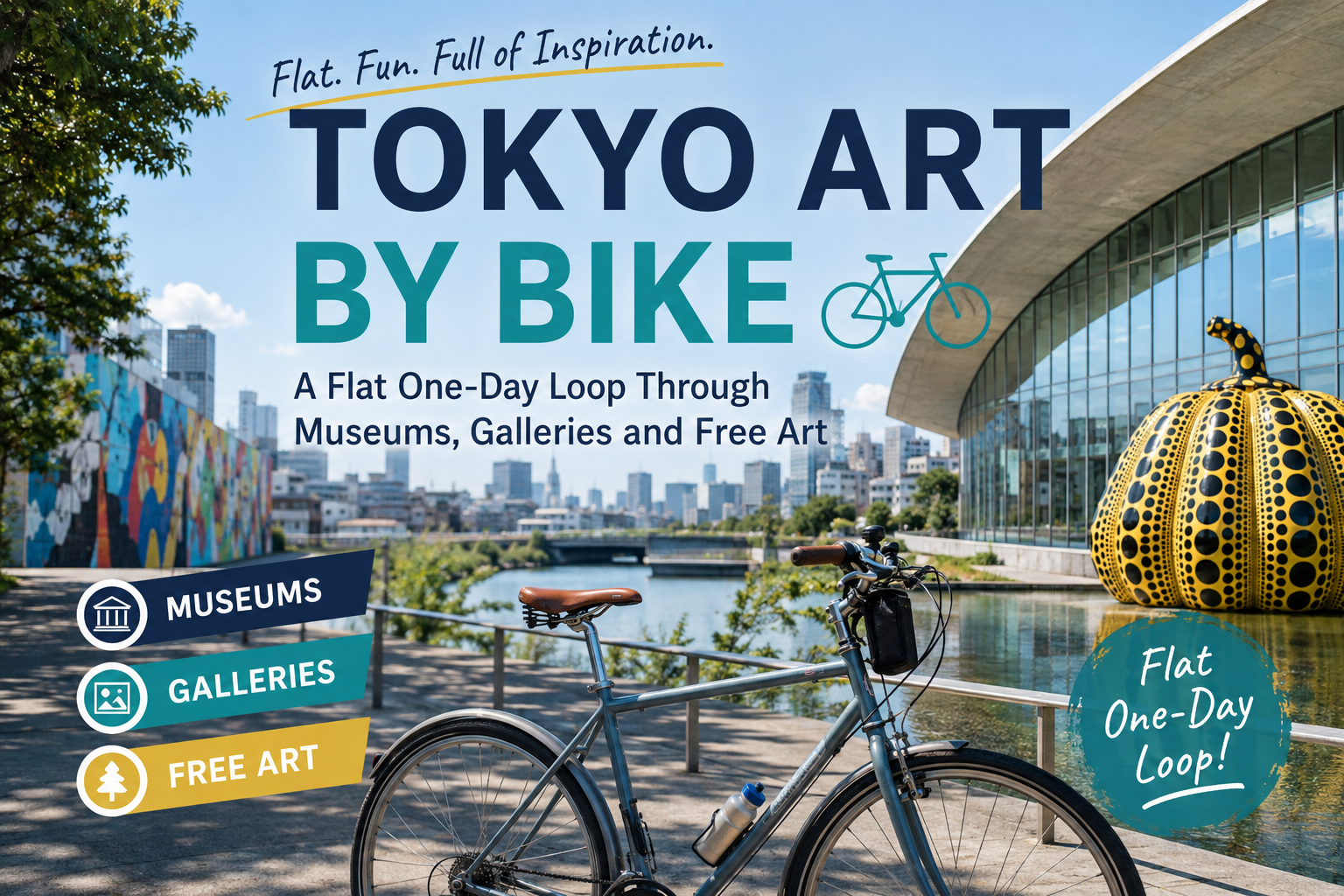
Tokyo has one of the densest concentrations of art in the world, and almost no good way to see it. The museums are scattered across five or six districts that don’t share a train line. A day of gallery-hopping by subway turns into a day of ticket gates, transfers and long underground walks between exits — and by the third museum you are too tired to look properly.
A bicycle fixes the geography. More usefully, it fixes the pace: you arrive at each building already outside, already looking at the city, instead of surfacing blinking from a tunnel. And the best of Tokyo’s art districts — Kyobashi, Ueno’s lower edge, Ryogoku, Kiyosumi-Shirakawa, Ginza — sit on reclaimed lowland at roughly sea level. The whole loop below is flat.
One warning before anything else, because it will ruin your day if you get it wrong.
First, Pick the Right Day of the Week
Tokyo museums cluster their closing days, and the clustering is brutal.
Monday Is a Wipeout — Do Not Ride This on a Monday
Closed on Mondays: the Tokyo National Museum, the National Museum of Western Art, the National Museum of Nature and Science, Artizon, Mitsubishi Ichigokan, the Museum of Contemporary Art Tokyo, the Sumida Hokusai Museum, the Edo-Tokyo Museum, Tokyo Station Gallery, Shiseido Gallery and the Nezu Museum. Commercial galleries close on Mondays too — and on Sundays. On a Monday this entire route is a series of locked doors.
The one exception is the Tokyo Metropolitan Art Museum in Ueno, which closes only on the first and third Mondays. Entry to the building is free.
Tuesday Kills Roppongi Specifically
The National Art Center, the Suntory Museum of Art and 21_21 DESIGN SIGHT all close on Tuesdays. The Mori Art Museum stays open but shuts at 17:00 instead of its usual 22:00. If Roppongi is on your list, don’t go on a Tuesday.
Friday Is the Best Day to Ride This
Friday late openings apply at the National Museum of Western Art (to 20:00), Artizon (20:00), Mitsubishi Ichigokan (21:00), the Tokyo National Museum (20:00), Tokyo Station Gallery (20:00), Suntory (20:00) and the National Art Center (20:00). That is roughly four extra museum-hours — which is exactly what a bike itinerary needs, because the riding eats your afternoon.
Wednesday and Thursday are close seconds. And note that a Monday public holiday inverts everything: most museums open and close the following Tuesday instead.
Getting a Bike — and Where to Put It
Rent for the Day
CycleTrip BASE in Kanda Sudacho is four minutes’ walk from JR Akihabara Station and sits almost exactly at the top of this loop. A cross bike is ¥4,500 for the first day (¥3,500 per day after that); electric-assist city bikes run ¥4,500–7,500. Lock, lights and liability insurance are included. English site, open daily 09:30–17:30 — plan the return, because the shop closes well before the Friday-night museums do.
The Parking Problem, and How to Beat It
Here is the thing nobody mentions in art guides: most Tokyo museums have no bicycle parking at all. WHAT MUSEUM in Tennozu says so outright. The Tokyo Metropolitan Art Museum asks visitors not to come by vehicle. MOT, the Tokyo National Museum and the Nezu Museum document car parking only.
So learn the ward lots instead, because a few of them are remarkably generous:
| Area | Where | Cost |
|---|---|---|
| Kyobashi | Museum Tower Kyobashi, east side (Artizon’s own) | 12 spaces, ¥100 per 2 h |
| Tokyo Station | Yaesu 2-chome Underground, 290 spaces | First 2 h free, then ¥100 / 8 h |
| Ginza | Ginza 6-chome Underground, under GINZA SIX | First 2 h free, then ¥100 / 8 h |
| Ueno | Ueno Park lot, Ueno South, Shinobazu | 24 h, about ¥150 per day |
| Roppongi | Roppongi Hills Cycle Park | 24 h, first 5 hours free |
| Tokyo Midtown | Midtown Cycle Park | First 3 hours free |
| Tennozu | Shinagawa ward lots | First 2 h free, then ¥150 / 24 h |
Two Traps at the Ginza Underground Lot
It is a fully mechanical “cycle tree” system, so your bike goes through a size check — an oversized rental frame or fat tyres can be rejected. It is also cash only, and the reception window runs 10:00–21:00, which means you cannot retrieve your bike outside those hours. Check both before you commit your afternoon to it.
The Share-Cycle Trick
If the parking maths gets annoying, docomo bike share covers every ward on this route and returns to docked ports rather than racks. Drop a bike at the port nearest a museum, spend two hours inside, take a different bike afterwards. It sidesteps the whole problem — at the cost of not having your own bike for the day.
The Route: The Flat East, About 22 km
Kyobashi → Ueno → Ryogoku → Kiyosumi-Shirakawa → Ginza → back. Every leg is under 5 km, and there is essentially no climbing.
1. Kyobashi — Four Venues Inside 600 Metres
Start here rather than in Ginza. This is the best-value block of ground in the entire city for art, and it is barely on the tourist map.
TODA Building
Opened in November 2024, and its lower six floors are given over entirely to art. The 3rd floor holds four commercial galleries under one roof — Taka Ishii, Tomio Koyama, KOSAKU KANECHIKA and Yutaka Kikutake — all free to walk into. The 6th floor is CREATIVE MUSEUM TOKYO, a 1,200 m² hall with five-metre ceilings running around four major exhibitions a year. Rotating public art fills the ground floors.
Artizon Museum
Four hundred metres away, and the collection that anchors the district: Impressionism, early modern European painting and Japanese Western-style work, in a building designed around the art rather than around a crowd. ¥1,200, 10:00–18:00 (Fridays to 20:00), closed Mondays. Timed entry in 30-minute slots — walk-ins are possible if the slot isn’t full, but book ahead. It also has the only dedicated museum bicycle parking on this route.
Tokyo Station Gallery
Inside the north dome of Tatsuno Kingo’s 1914 red-brick station. The gallery walls deliberately expose the original brickwork and ironwork, so the room competes with whatever is hanging on it. 10:00–18:00, Fridays to 20:00, closed Mondays.
2. Ueno — the Museum Park
Two and a half kilometres north, with one short ramp up onto the Ueno plateau. Five major institutions share one park, which sounds efficient and is actually a trap: you cannot do them all, and trying will exhaust you before lunch.
What to Prioritise
If you pick one, make it the National Museum of Western Art — the Le Corbusier building is an inscribed UNESCO World Heritage site, the permanent collection is only ¥500, and it stays open to 20:00 on Fridays and Saturdays. The Tokyo National Museum (¥1,000) is the deeper collection but needs half a day to do honestly. The Tokyo Metropolitan Art Museum is free to enter and the most likely thing here to be open on a Monday.
Practicalities
Park at the Ueno Park lot or the Shinobazu lot — around ¥150 for the day, 24 hours — and walk the park. Riding through the central sections is not welcome, and it is busy enough that you wouldn’t enjoy it anyway.
3. Ryogoku — the Newest Thing in Tokyo
Three and a half flat kilometres east across the Sumida, and the reason to include Ryogoku in 2026 is simple: the Edo-Tokyo Museum reopened on 31 March 2026 after roughly four years closed and its first major overhaul in three decades.
What is new inside: a noren curtain marking the threshold between Edo and the modern city, eleven suits of samurai armour staged together, the complete set of Hiroshige’s One Hundred Famous Views of Edo, a walk-through reconstruction of the Asakusa Hanayashiki gate, and large-scale projections that use the building’s own geometry — with spatial direction by Shohei Shigematsu of OMA. Permanent exhibition ¥800, 09:30–17:30 (Saturdays to 19:30), closed Mondays. There is also projection mapping on the third floor in the evening, weather permitting.
Two hundred and fifty metres away sits the Sumida Hokusai Museum, and the building is the point: Kazuyo Sejima’s mirrored aluminium block, slashed with angular slits that reflect the surrounding low-rise back at itself. The permanent gallery is ¥400. Closed Mondays.
4. Kiyosumi-Shirakawa — Contemporary Art and Very Good Coffee
Two and a half kilometres south. The Museum of Contemporary Art Tokyo sits inside Kiba Park with one of the strongest postwar Japanese collections anywhere — ¥500 for the collection display, 10:00–18:00, closed Mondays.
Around it is a genuine gallery neighbourhood: ANDO GALLERY in an ivy-covered converted warehouse, KANA KAWANISHI, Satoko Oe Contemporary by the Onagi canal, HARMAS GALLERY down a residential alley. All free. All closed Sundays and Mondays.
Kiyosumi Garden is ¥150 and open every day but New Year — a Meiji stroll garden built by Mitsubishi’s founder, famous for its collected stones and the stepping-stone crossing over the pond. And this is Tokyo’s coffee-roastery district: the Blue Bottle flagship is open daily 08:00–19:00, with ARiSE and Allpress within a few streets. Lock the bike properly — Blue Bottle explicitly asks visitors not to leave bikes on the street.
5. Ginza — Free Galleries, and One Warning
Four and a half kilometres west along Eitai-dori. Ginza’s reputation is expensive shopping; its actual art is mostly free.
The Free Walk-Ins
- Shiseido Gallery — basement of the Shiseido Building, 11:00–19:00, closed Mondays
- ginza graphic gallery (ggg) — graphic design, 11:00–19:00, closed Sundays and holidays
- Ginza Maison Hermès Le Forum — 8th floor of the Renzo Piano glass-block building, 11:00–20:00, no regular closing day
- POLA MUSEUM ANNEX — 11:00–20:00, open daily during exhibition runs
There is no single day when all four are open — ggg closes Sunday, Shiseido closes Monday. Wednesday to Saturday catches everything.
The Hokoten Warning
On weekends and public holidays, Chuo-dori from 1-chome to 8-chome becomes a pedestrian paradise — 12:00–18:00 April to September, 12:00–17:00 October to March — and Chuo City states plainly that bicycles may not pass through. Dismount and walk, or route one block over on Sotobori-dori or Showa-dori.
Free, and Genuinely Worth Stopping For
Julian Opie’s “Marathon. Women.” runs in the central atrium of GINZA SIX, visible from floors two to five, installed in September 2025 and scheduled to stay up to April 2027. Costs nothing to look at.
From Ginza it is four flat kilometres back to Kanda.
If You Have a Second Day: Hills and Water
Roppongi — Climb Once, on Fresh Legs
Roppongi sits on the Yamanote uplands, about thirty metres above the lowland you have been riding. The climb from Ginza is four kilometres with one sustained pull up Roppongi-dori from Tameike-Sanno — not steep, but unrelenting and unpleasant in multi-lane traffic. Ride into Roppongi and out toward Shinagawa, never the reverse.
The reward is density. The Mori Art Museum on the 53rd floor is open to 22:00 every day except Tuesday, which makes it the natural last stop of a cycling day. The National Art Center‘s Kurokawa Kisho building is worth walking into without a ticket. 21_21 DESIGN SIGHT is Tadao Ando’s half-buried steel plate. And complex665 stacks three serious galleries — Taka Ishii, ShugoArts and Tomio Koyama — in one free building. Keep your ticket stub: the Roppongi Art Triangle gives ¥100 off at Suntory if you show one from the Mori, the National Art Center or 21_21.
Parking is unusually good here. Roppongi Hills Cycle Park gives you the first five hours free, 24 hours a day.
Tennozu Isle — the Bike-Friendliest Art District in Tokyo
Seven kilometres from Roppongi, net downhill through the Furukawa valley. Tennozu is a flat warehouse island in the canals, and it is the closest Tokyo gets to a purpose-built art district.
TERRADA ART COMPLEX I and II stack roughly eighteen contemporary galleries across two adjacent buildings — MAKI, KOTARO NUKAGA, ANOMALY, SCAI PARK, Taka Ishii, ShugoArts Studio and more — all free, most open around 11:00 or 12:00 to 18:00 or 19:00, closed Sundays and Mondays. WHAT MUSEUM shows work from private collections and storage (11:00–18:00, timed slots, and note it has no bicycle parking). WHAT CAFE is 800 m² of gallery wall where everything is by an emerging artist and everything is for sale. PIGMENT TOKYO is a pigment laboratory under a Kengo Kuma bamboo ceiling, with a wall of roughly 4,500 colours — free to browse.
Shinagawa ward lots give you the first two hours free, then ¥150 for 24 hours. Expect to dismount on the canal-side boardwalk sections and ride the perimeter roads instead.
Free Art That Needs No Ticket at All
Shinjuku i-Land
An office plaza in West Shinjuku with a startling amount of serious work standing outdoors, free, around the clock. Everyone photographs Robert Indiana’s LOVE; almost nobody notices that Roy Lichtenstein’s Tokyo Brushstroke I & II, a Daniel Buren, a Sol LeWitt wall drawing and pieces by Giuseppe Penone, Giulio Paolini and Luciano Fabro are standing on the same corner.
Palace Cycling — Sunday Only, and Free
Every Sunday from 10:00 to 16:00, Uchibori-dori is closed to cars for about three kilometres beneath the Imperial Palace moat and walls. Free, run by the Japan Bicycle Promotion Association, cancelled for rain or events. It is the only place in central Tokyo where you can ride a wide road with no traffic on it at all — and it finishes just as Ginza’s pedestrian hours begin, 1.5 km away.
The Building That Isn’t There Any More
If you came looking for the Nakagin Capsule Tower: it was demolished in 2022. But twenty-three capsules were salvaged and restored, and two of them are installed at SHUTL, Shochiku’s arts space in Higashi-Ginza — directly on your Ginza leg. Another entered the collection of MoMA in New York. The building is gone; the idea travelled.
Wrap-Up
Three or four paid interiors is an honest maximum for one day, and the free galleries between them are what make the ride feel like a day out rather than a checklist. Pick a Friday, start in Kyobashi before the crowds reach Ueno, take the Sumida crossing to Ryogoku in the flat middle of the afternoon, and end somewhere with coffee in it.
And check what’s closed before you unlock the bike. In this city that single habit is worth more than any amount of fitness.