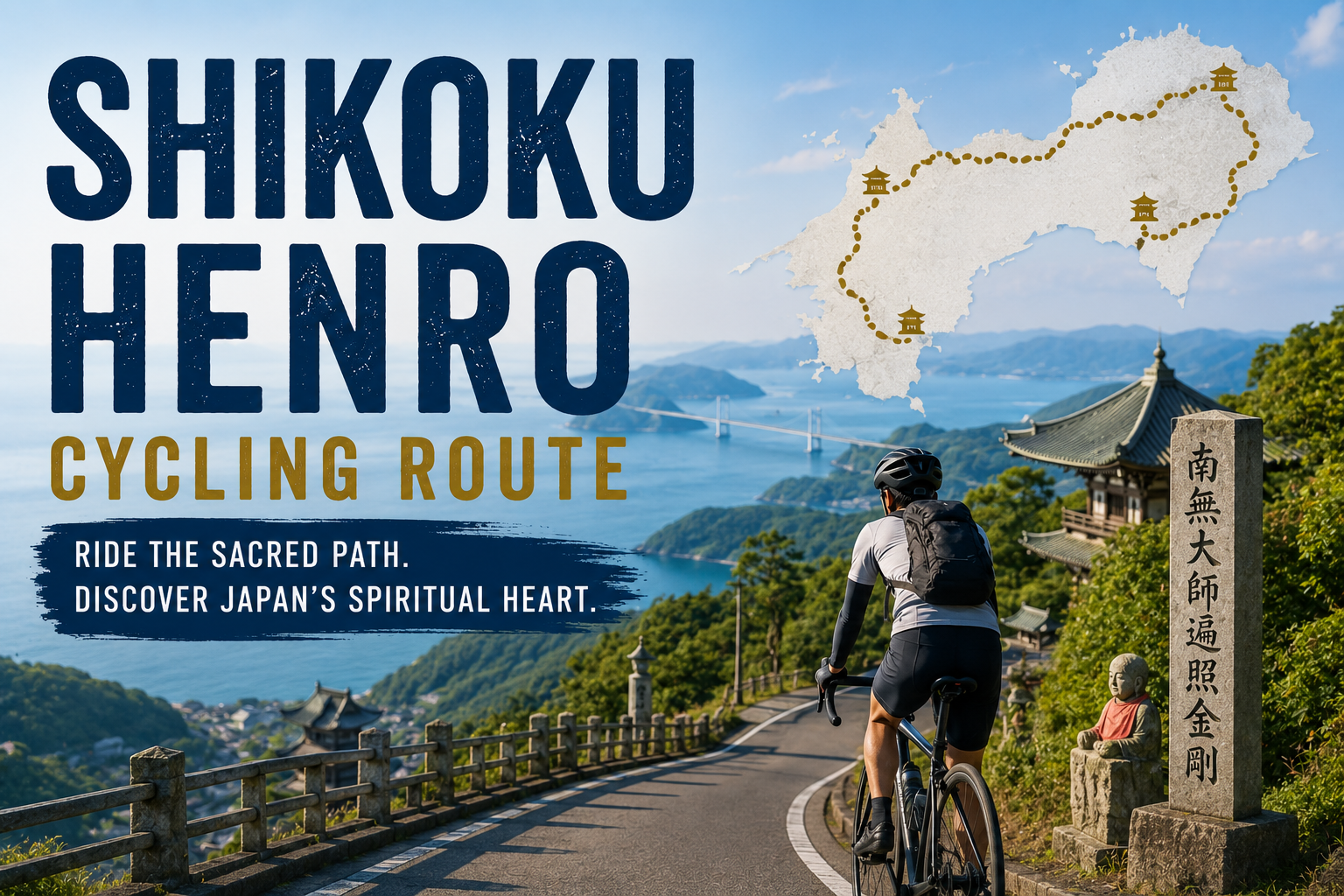
Cycling the Shikoku Pilgrimage: A Two-Week Journey Along a 1,200-Year-Old Path
Ride through ancient cedar forests, past moss-covered mountain temples, and along coastlines where the Pacific meets rugged volcanic cliffs — all while tracing the footsteps of a thousand-year-old Buddhist pilgrimage.
The Shikoku Henro is one of Japan’s most legendary journeys, and cycling it transforms the experience into something truly unique: two weeks that blend spiritual exploration, world-class cycling routes, and an immersion into the Japanese countryside that only a small number of foreign travelers ever get to experience.
Shikoku, Japan’s fourth-largest island, lies southwest of Osaka and Hiroshima, connected to Honshu by famous bridges spanning the Seto Inland Sea. It’s a world apart — sparsely visited, ruggedly natural, and steeped in pilgrimage tradition. The Henro is a 1,200-kilometer pilgrimage route linking 88 Buddhist temples associated with Kūkai (Kōbō Daishi), traditionally walked (or cycled, or driven) in its entirety. Most pilgrims spend 30 to 60 days walking the route, but by bicycle you can complete a satisfying two-week course covering the major temples, the most dramatic scenery, and the cultural heart of the pilgrimage.
This guide is a complete roadmap for a two-week cycling experience — covering everything from planning and packing to daily routes, lodging, local food, and the small points of etiquette that turn this into more than just a bike trip.
Why Cycle the Shikoku Henro?
The Shikoku Henro has been walked continuously for over 1,200 years, making it one of the oldest pilgrimage routes in the world. Unlike the Camino de Santiago, which has increasingly developed tourist infrastructure, the Shikoku Henro retains a deep sense of tradition and authenticity. Much of the route passes through rural villages, coastal fishing towns, and forested mountain paths, where a foreign traveler on a loaded touring bike is still met with genuine curiosity and warmth.
Cycling occupies a middle ground between the meditative pace of walking and the detachment of driving. You’ll cover a respectable 70–120 kilometers a day — fast enough to make real progress, yet slow enough to catch the scent of orange blossoms in Ehime, listen to the bell of a mountain temple, or strike up a conversation with an elderly pilgrim resting on a roadside bench.
Then there’s the concept of osettai — a deeply rooted Japanese tradition of giving gifts to pilgrims with nothing expected in return. People along the route will press mikan oranges, canned coffee, or small amounts of money into your hands. This isn’t charity; it’s a spiritual practice. By graciously accepting osettai, the giver earns merit. It’s one of the most moving aspects of Japanese culture you’ll encounter anywhere.
The Two-Week Course: What to Know
The full route covering all 88 temples spans roughly 1,200 kilometers. In two weeks (14 cycling days), depending on your route choices, you’ll cover approximately 700–900 kilometers, visit 40–55 temples, and experience all four prefectures of Shikoku — Tokushima (the place of awakening resolve), Kōchi (the place of ascetic discipline), Ehime (the place of enlightenment), and Kagawa (the place of nirvana).
This isn’t a sprint — it’s a rhythm. Days typically begin early; many pilgrims wake before dawn to reach temples before the tour buses arrive. Each day ends with a bath, a local meal, and deep, dreamless sleep.
Route Overview: The 14-Day Itinerary
Before You Begin: Starting Point and Access
The traditional starting point is Ryōzen-ji, in Naruto City, Tokushima Prefecture. From Osaka (Shin-Osaka Station), take the JR limited express Uzu to Tokushima Station (about 2.5 hours), then cycle 13 km north. From Tokyo, fly from Haneda to Tokushima Airport (Awa Odori Airport), about 65 minutes.
Alternatively, take the scenic Naruto Strait ferry from Higashi-Maiko Port in Kobe to Naruto — a crossing over one of the world’s most powerful tidal currents, and a beautiful introduction to Shikoku.
Day 1: Naruto to Tokushima City (60 km)
Temples visited: T1 Ryōzen-ji → T6 Anraku-ji
Set off for Ryōzen-ji at dawn, when incense smoke drifts across the grounds and you’ll have the temple nearly to yourself. Pick up your nōkyōchō (temple stamp book) here — it will fill with red seals and calligraphy over the coming days and become a treasured keepsake. If you want the traditional pilgrim’s look, pick up a white vest (hakui) and a walking staff (kongōzue) too. Entirely optional, but locals will welcome you warmly and you’ll likely receive more osettai.
The first six temples cluster in the flat farmland north of Tokushima City, making for a gentle warm-up. Riding is easy, with quiet prefectural roads through rice paddies and a mild headwind off the Naruto Strait. You’ll arrive in Tokushima City by afternoon — a charming riverside town perfect for an evening stroll along the Shinmachi River.
Lodging: Business hotels or minshuku (family-run guesthouses) in Tokushima City. Minshuku typically run ¥4,000–8,000 per night, often including meals.
Day 2: Tokushima to Kamojima (75 km)
Temples visited: T7 Jūraku-ji → T14 Jōraku-ji
This stretch follows the Yoshino River valley deep into Tokushima Prefecture. The terrain varies — gentle climbs toward the foothills and several river crossings on narrow bridges. The 11th temple, Fujii-dera, sits at the base of a major pass and marks the entrance to the route’s first serious challenge, the henro korogashi (literally “pilgrim-tumbler”). By bike, this section detours onto paved roads, adding distance but avoiding the unmaintained mountain trail.
The scenery here is lush and quiet. Small family farms dot the roadside, and you may encounter groups of elderly Japanese pilgrims walking slowly in white vests, leaning on their staffs. Exchange bows and the greeting “dōgyō ninin” — meaning that Kūkai travels with you in spirit.
Day 3: Kamojima to Kaifu (90 km)
Temples visited: T15 Kokubun-ji → T23 Yakuō-ji
The route turns south toward Kōchi Prefecture, marking a turning point in the journey. Past Annan City, the road follows the Pacific coastline, forming one of the island’s finest scenic cycling stretches. The 23rd temple, Yakuō-ji, is famous for its stone steps, where pilgrims place coins on each step as offerings — 42 steps for men (an unlucky age) and 33 for women (also an unlucky age). South from here, the Muroto Cape coastline offers some of the most striking scenery in Japan.
Food: Tokushima Prefecture is known for Tokushima ramen — a rich pork-bone broth with a dark soy tare, topped with a raw egg cracked in at the table — and for sudachi, a local citrus used in everything from sashimi to noodles to sake. Also worth trying is handa sōmen, ultra-thin wheat noodles served cold with a dipping sauce.
Day 4: Kaifu to Muroto (70 km) — Cape Muroto
Temples visited: T24 Hotsumisaki-ji
This is one of the most exhilarating days of the entire trip. The road from Kaifu to Cape Muroto runs unbroken along the Pacific coastline, at times just five meters from the water, rounding headland after headland with the ocean stretching to the horizon. On a clear day, you can almost see the curvature of the earth on the water’s surface. This coast faces the open Pacific directly, and the waves are immense.
Cape Muroto itself is a geological wonder — jagged black basalt columns thrust up by tectonic activity, tidal pools teeming with marine life, and a lighthouse that has guided ships since 1899. At the cape’s summit stands the 24th temple, Hotsumisaki-ji, reached via a steep 3-kilometer climb that rewards you with sweeping ocean views. Legend holds that a young Kūkai meditated in a cave beneath this temple and experienced his first awakening there.
Descending back to sea level brings you to Muroto, a small fishing town famous for katsuo no tataki — bonito seared over straw flames and served with citrus ponzu sauce. Don’t miss it.
Day 5: Muroto to Kōchi City (110 km)
Temples visited: T25 Shinshō-ji → T33 Sekkei-ji
With a tailwind from the southeast (usually), push through a longer day. The road from Muroto to Kōchi City follows the Tosa Bay coastline, calmer and gentler than the Muroto coast. Around Aki City, temples cluster closely together, making it easy to collect stamps without major detours. You’ll reach Kōchi City, Shikoku’s largest city, by late afternoon — a welcome dose of urban comfort after days in the countryside.
Kōchi Castle is the only castle in Japan where both the main keep and the honmaru goten (palace) survive intact. The Hirome Market night scene is legendary, with dozens of food stalls inside an indoor market serving famous Tosa cuisine and Kōchi’s beloved yuzu sake. Expect to stay out a little later than usual.
Lodging: Kōchi City has many good business hotels near the station. After exploring the coast, treat yourself to a proper hotel stay and soak your tired legs in a real bathtub.
Day 6: Kōchi City to Usa (80 km)
Temples visited: T34 Tanema-ji → T37 Iwamoto-ji
Leaving Kōchi, the route crosses the Niyodo River — famous for water clarity so pure it turns a stunning turquoise in sunlight — and climbs into the inland mountains of western Kōchi. The 37th temple, Iwamoto-ji, stands out among the 88: the ceiling of its main hall is covered with painted panels donated by worshippers over decades, forming a kaleidoscopic canopy of folk art, ink paintings, and even cartoon characters.
Day 7: Usa to Cape Ashizuri (95 km) — Cape Ashizuri
Temples visited: T38 Kongōfuku-ji
The route’s other great cape, Ashizuri, sits at Shikoku’s southernmost point, jutting into the Pacific. It’s a dramatic headland of granite cliffs draped in subtropical vegetation, with 70-meter sea cliffs plunging into the water. Kongōfuku-ji, tucked into the forest at the cape’s tip, is surrounded by ancient camellia trees that bloom vivid red from winter into spring.
The road to the cape winds through Ashizuri-Uwakai National Park, one of Japan’s most remote and beautiful stretches of coastal forest. Offshore, sea turtles nest along this coast (a major nesting ground), and the temple gardens are home to the resident Japanese paradise flycatcher.
This marks the turnaround point of the route’s southern loop. From Ashizuri, the path turns northwest into Ehime Prefecture.
Day 8: Ashizuri to Uwajima (100 km)
Temples visited: T39 Enkō-ji → T40 Kanjizai-ji
A day crossing the Shimo-mo Bay peninsula into Ehime. The road north from Ashizuri passes through mikan orchards terraced in geometric rows across the hillsides — especially beautiful in October and November when the fruit ripens. The 40th temple, Kanjizai-ji, marks the border with Ehime, the route’s third prefecture.
Uwajima is a former castle town known for two unexpected specialties: taimeshi, whole sea bream served over seasoned rice with dashi, and bullfighting — a local tradition where two bulls lock horns and push until one retreats. It’s not violent; matches are held on specific festival days.
Day 9: Uwajima to Matsuyama (110 km)
Temples visited: T41 Ryūkō-ji → T52 Taisan-ji
The longest day of the itinerary, but mostly flat farmland through Ehime’s river valleys. Temples are more densely packed here than anywhere else on the route, making for a satisfying day of stamp collecting. Matsuyama, Shikoku’s largest city, is a favorite among many travelers — a genuine castle town with a well-preserved tram network, historic hot springs, and literary connections that give it real cultural depth.
Don’t miss: Dōgo Onsen, one of Japan’s oldest hot springs, said to have a 3,000-year history. The main building, a three-story wooden structure from 1894, is a nationally designated Important Cultural Property and one of the most photographed buildings in Japan. After nine days of cycling, a soak here is essential — queue for the Kami-no-Yu bath, then relax upstairs in a yukata with tea afterward.
Matsuyama is the birthplace of haiku master Masaoka Shiki and the setting for Natsume Sōseki’s novel Botchan. The city takes great pride in both connections.
Day 10: Rest Day and Cultural Exploration in Matsuyama
Take a full day to relax in Matsuyama. Visit Matsuyama Castle, one of Japan’s twelve surviving original castles, perched on a hill above the city center, reachable by ropeway or a steep hiking trail. Unlike many reconstructed concrete castles elsewhere in Japan, the interior retains its original wooden construction, offering an authentic feel of feudal-era Japan.
In the afternoon, visit the Shiki Memorial Museum or wander the arcade shopping streets near Ōkaidō Station. In the evening, return to Dōgo Onsen — this time to soak at the newly renovated Tsubaki-no-yu annex.
Day 11: Matsuyama to Imabari (55 km)
Temples visited: T53 Enmei-ji → T59 Kokubun-ji
A short day heading north toward Imabari and the foot of the Shimanami Kaidō. Temples in this stretch are scattered through quiet residential neighborhoods, a contrast to the mountain temples of earlier days but no less spiritually significant. The 59th temple, near the northern edge of Matsuyama, is a large temple complex notable for its huge Niō gate, visible from the road.
Imabari is the gateway to the Shimanami Kaidō, arguably Japan’s most famous cycling route. Even without extending your trip to cross the bridges, a stroll along Imabari’s harbor as the Seto Inland Sea turns gold at dusk is one of the most peaceful, beautiful experiences in Shikoku.
Day 12: Imabari to Saijō (80 km)
Temples visited: T60 Yokomine-ji → T64 Maegami-ji
The final border crossing back from Ehime toward Kagawa Prefecture brings the route’s last major challenge: Yokomine-ji (temple 60), at 745 meters elevation. An approximately 8-kilometer steep forest climb, it’s genuinely tough, but the view of the Seto Inland Sea from the temple grounds makes the effort worthwhile. On clear days, you can see all the way to Hiroshima Prefecture.
Day 13: Saijō to Zentsū-ji (90 km)
Temples visited: T65 Sankaku-ji → T75 Zentsū-ji
Entering Kagawa Prefecture, the place of nirvana and Shikoku’s final prefecture, brings a special sense of accomplishment at this stage — you’ve crossed the entire island. The scenery shifts to gentle rolling hills and open plains, deepening the sense that the journey’s end is near. The 75th temple, Zentsū-ji, is one of the most sacred sites on the pilgrimage — the birthplace of Kūkai himself. The grounds span 45,000 square meters, and a famous underground passage beneath the main hall lets visitors walk through complete darkness as a meditation on impermanence.
Day 14: Zentsū-ji to Ōkubo-ji (Temple 88) to Takamatsu (80 km)
Temples visited: T76 Kinzō-ji → T88 Ōkubo-ji
The final day of the pilgrimage. The 88th temple, Ōkubo-ji, is reached by crossing the Nyotai-san pass — a final climb that feels almost symbolic. The approach through cedar forest is quiet and beautiful. Weekends draw large crowds, so a weekday morning visit is best if possible. At the temple, pilgrims traditionally dedicate their walking staffs, symbolizing Kūkai’s continued presence in the world, guiding future pilgrims.
From the 88th temple, descend to Nagao Station and take the Kotoden line (or continue by bike) to Takamatsu, the capital of Kagawa Prefecture and the end point of the journey. Celebrate in Takamatsu’s famous udon district (Kagawa produces more Sanuki udon than anywhere else in Japan), then cross the Seto Inland Sea by ferry or train back to Osaka or Okayama.
Practical Information
Best Season
Spring (March–May): Cherry blossoms in April are spectacular, with ideal temperatures of 15–22°C. The main risk is spring rain, especially in late May.
Autumn (September–November): Arguably the best season of the year — temperatures of 18–26°C, clear skies, mikan harvest, and autumn foliage at mountain temples. Typhoon risk along the Pacific coast drops significantly after mid-October.
Avoid: July and August (extreme heat along the Kōchi coast, temperatures above 35°C, high humidity, and typhoon season), and January–February (mountain roads can freeze, and some temple access roads close).
Bicycle Recommendations
A touring bike or an endurance road bike with tires 32mm or wider is ideal. The entire route is paved, so a gravel bike is overkill, but 23mm road tires will feel rough on some of the rougher prefectural roads. Minimum kit:
- Two spare inner tubes
- Puncture repair kit and tire levers
- A mini pump (CO₂ cartridges are convenient for travel)
- Chain lubricant (mountain humidity is hard on drivetrains)
- Zip ties and duct tape (all-purpose problem solvers)
For bike rentals, both Mac Cycle Shop in Tokushima City and Cycle Sports Matsuyama offer touring bikes suited to the Henro. Book ahead during busy seasons.
Accommodation
Minshuku: Family-run guesthouses are the heart of the wandering experience, typically ¥5,000–8,000 per night with dinner and breakfast included. Book by phone or via shikoku88.net. Hosts will often do your laundry overnight.
Zenkon-yado: Free pilgrim lodging maintained by local residents along the route, ranging from simple huts to private homes. First-come, first-served, and a wonderful example of the osettai culture.
Business hotels: Widely available in the major cities (Tokushima, Kōchi, Matsuyama, Takamatsu). Rates run ¥7,000–12,000 — useful when you need privacy on rest days.
Temple lodging (shukubō): Available at about 10 of the 88 temples. Offers a deeper experience with evening prayer services, shared shōjin ryōri (vegetarian temple cuisine), and tatami rooms. Popular temples should be booked months in advance.
Budget
| Category | Daily Budget (¥) | Notes |
|---|---|---|
| Lodging (minshuku, 2 meals) | ¥6,000–8,000 | Budget ¥10,000+ for hotel nights on rest days |
| Lunch and snacks | ¥1,500–2,500 | Convenience stores, noodle shops |
| Temple offerings | ¥500–1,500 | ¥100–200 per temple |
| Miscellaneous (onsen, transport) | ¥500–1,000 | |
| Daily total | ¥8,500–13,000 | Approx. $55–85 USD |
Temple Rituals
All 88 temples follow the same sequence of rituals, which typically takes 15–25 minutes to complete properly:
- Bow once at the main gate (sanmon) upon entering and leaving.
- Wash your hands and mouth at the purification fountain (temizuya).
- Light one candle and one stick of incense at both the main hall (hondō) and the Daishi hall.
- Deposit your name slip (osamefuda) — these can be purchased at Temple 1.
- Recite a sutra (printed cards are provided; non-Buddhists are not expected to recite the full text).
- Receive your temple stamp at the nōkyōsho (stamp office). Fees run ¥300–500 per temple.
Non-Buddhists are entirely welcome. No religious faith is required at the temples — the Henro is understood as a journey where anyone can find personal meaning, in whatever form that takes.
Language
English is not widely spoken outside the major cities. Learn these phrases before you arrive:
- Sumimasen — Excuse me / I’m sorry
- Doko desu ka — Where is [place]?
- Minshuku wa arimasu ka? — Is there a guesthouse?
- Arigatō gozaimasu — Thank you
- Osettai, itadakimasu — I gratefully accept your offering
Local Food Guide: A Culinary Journey Through Four Prefectures
Tokushima Prefecture
- Tokushima Ramen: Rich pork-bone broth with a dark soy tare and a raw egg cracked in at the table. A common local breakfast order.
- Sudachi: A golf-ball-sized green citrus unique to Tokushima, squeezed over sashimi, noodles, beer — nearly everything.
- Handa Sōmen: Ultra-thin wheat noodles aged for two years for a distinctive chew, served cold with a rich dipping broth.
Kōchi Prefecture
- Katsuo no Tataki: Thick-cut bonito lightly seared over burning rice straw, served with garlic and ginger. Kōchi’s signature dish.
- Sawachi Ryōri: A festive Tosa-style dish — a massive platter piled with sashimi, grilled fish, pickles, and simmered dishes.
- Yuzu Sake and Yuzu Products: Kōchi is a major yuzu-growing region, and its yuzu-flavored sake and ponzu are exported nationwide.
Ehime Prefecture
- Mikan: Ehime is Japan’s largest mikan-producing region. Try one fresh from a roadside stall — unmatched sweetness.
- Taimeshi: Uwajima-style — whole sea bream arranged over seasoned rice, served with raw egg and dashi, mixed together before eating.
- Jakoten: Fried fish-paste cakes unique to the Uwakai coastal region of Ehime. Sold hot, piece by piece, from street stalls — a perfect match for beer.
Kagawa Prefecture
- Sanuki Udon: One reason alone to visit Kagawa. Thick, hand-pulled wheat noodles with a distinctive chewy texture, served in a light dashi broth. Order it plain (kake udon) first to appreciate the noodles themselves. Kagawa has over 700 udon shops for a population of one million.
- Shōyu Confections: Kagawa is one of Japan’s leading soy sauce producers, and local confectioners use it to make caramels, cookies, and even ice cream.
Cultural Insights for Cycling Pilgrims
The White Vest and Its Meaning
The traditional pilgrim’s white vest (hakui) symbolizes readiness for death. Historically, pilgrims wore white burial clothing because the journey was genuinely dangerous and completion was never guaranteed. Today, the hakui functions as a social signal — locals recognize you as a pilgrim on sight and often extend extra kindness: rides, directions, smiles. Even if you cycle in regular clothes, consider carrying a hakui for temple visits.
The Osettai Protocol
If offered osettai, always accept it with both hands and a bow, saying “osettai, itadakimasu.” Never refuse — refusing denies the giver their merit and is considered unkind. If the gift is impractical to carry (say, a large bag of mikan at kilometer 60 of a 100-kilometer day), accept it graciously, then pass it on to the next pilgrim, or leave it at a temple with a note.
Temple Photography
Most temples allow photography in courtyards and gardens. Interiors of the main hall and Daishi hall vary by temple — check posted signs, and ask if unsure. Never photograph other pilgrims performing ritual prayers without their permission.
The Spiritual Dimension
You don’t need to be Buddhist to walk the Henro, but engaging with its spiritual framework enriches the experience. The route represents four stages of Buddhist practice: Tokushima (awakening resolve), Kōchi (ascetic discipline), Ehime (enlightenment), and Kagawa (nirvana). Even secular pilgrims often come away with some kind of spiritual sense — whatever they choose to call it — after two weeks of physical challenge, natural beauty, and human kindness.
Getting There and Getting Home
Arriving in Japan
International flights connect through Osaka Kansai International Airport (KIX) or Tokyo Haneda (HND). From KIX, take the JR limited express Haruka to Shin-Osaka, then the Shinkansen to Okayama, followed by the Marine Liner to Takamatsu, or take JR via the Seto Ōhashi Bridge directly to Tokushima. Total travel time from KIX to Tokushima is 3–4 hours.
Transporting Your Bicycle
On Japan’s Shinkansen, bicycles can be brought aboard for a small additional fee if packed in a dedicated bike bag (rinko bag) — reserve ahead of time. On local trains, folding bicycles ride free. On the Nankai Ferry from Osaka to Tokushima (a 12-hour crossing, with overnight service), fully assembled bicycles can be brought aboard for an additional ¥500–1,000. This is a convenient option that saves a day of travel and lets you rest before setting off.
The End of the Journey
From Takamatsu, the JR Marine Liner crosses the Seto Inland Sea to Okayama in 55 minutes, connecting to the Shinkansen for Tokyo or Osaka. Ferries also run to Kobe and Osaka. The view of the bridges spanning the Seto Inland Sea at sunset, seen from the train window as you leave Shikoku for Honshu, offers a poetic farewell to the island.
Final Thoughts: What This Journey Gives You
Most people who complete even part of the Shikoku Henro by bicycle describe the experience in similar terms: something shifted. Not dramatically, not like a bolt of revelation from the sky, but a quiet, lasting reorientation. Days become simple — ride, eat, bathe, sleep. Temples accumulate not as tourist checkboxes but like punctuation marks in a long meditation. The osettai, however small, stay with you — the elderly woman who pressed a 500-yen coin into your hand outside Temple 41; the truck driver who pulled over just to make sure you hadn’t taken a wrong turn; rain falling on a mountain trail; the scent of incense and cedar; the Pacific coastline lit by morning sun.
Shikoku doesn’t reveal its charms quickly. It rewards those who travel slowly — the cyclist who stops for the view, who sits on temple steps eating a mikan and watches the mountains for a while. Bring that kind of attention to the journey, and Shikoku will give back in kind.
Pack light. Leave early. Take every orange offered to you.
Quick Reference: Key Information
| Detail | Information |
|---|---|
| Total distance (2-week version) | Approx. 750–900 km |
| Temples visited | 40–55 of 88 |
| Daily distance | 55–110 km |
| Best season | April–May, October–November |
| Starting point | Temple 1, Ryōzen-ji, Naruto City, Tokushima |
| Ending point | Temple 88, Ōkubo-ji → Takamatsu |
| Daily budget | ¥8,500–13,000 (approx. $55–85) |
| Recommended bike | Touring or endurance road bike, 32mm+ tires |
| Language difficulty | Intermediate (basic Japanese helpful) |
| Physical difficulty | Intermediate to advanced (mountain pass climbs) |